College counseling has become one of the most complex functions in international schools. Counselors guide students through academic choices, university research, applications, family expectations, financial questions, career uncertainty, and emotional setbacks. They are advisors, advocates, data managers, communicators, and institutional memory keepers.
Yet too many counseling offices are built around individuals rather than systems.
A strong counselor can carry a program for years through dedication and personal relationships. They remember which student needs encouragement, which family is anxious, which teacher writes strong recommendations, and which university representative values early communication. But when that knowledge lives mostly in one person’s inbox, memory, or habits, the office becomes fragile.
The key question for schools is no longer only: “Do we have good counselors?” It is: “Have we built a counseling system that remains strong even when people change?”
This matters because counseling is long-term work. Counselors often track students across three or four years. They see the full arc of growth: how a quiet student becomes a confident applicant, how family pressure shapes choices, how early academic decisions affect later university options. Few other departments see students with that same continuity.
At the same time, counseling is often low visibility. Because much of the work is confidential, the most meaningful interventions may never appear in public reports. A student who avoids a poor-fit choice, a family that gains clarity, or an applicant who recovers from rejection may not show up in a headline outcome.
That invisibility can become a structural problem. School leaders may notice final university lists, but not the years of advising, emotional support, data tracking, and internal coordination behind them. Parents may focus on recognizable university names while missing the broader work of helping students find places where they can thrive.
Sustainable counseling offices need a stronger seat at the table. They should be integrated into academic planning, wellbeing, parent education, curriculum conversations, and leadership strategy. Their insight belongs in discussions about course offerings, workload, communication, alumni outcomes, and school positioning.
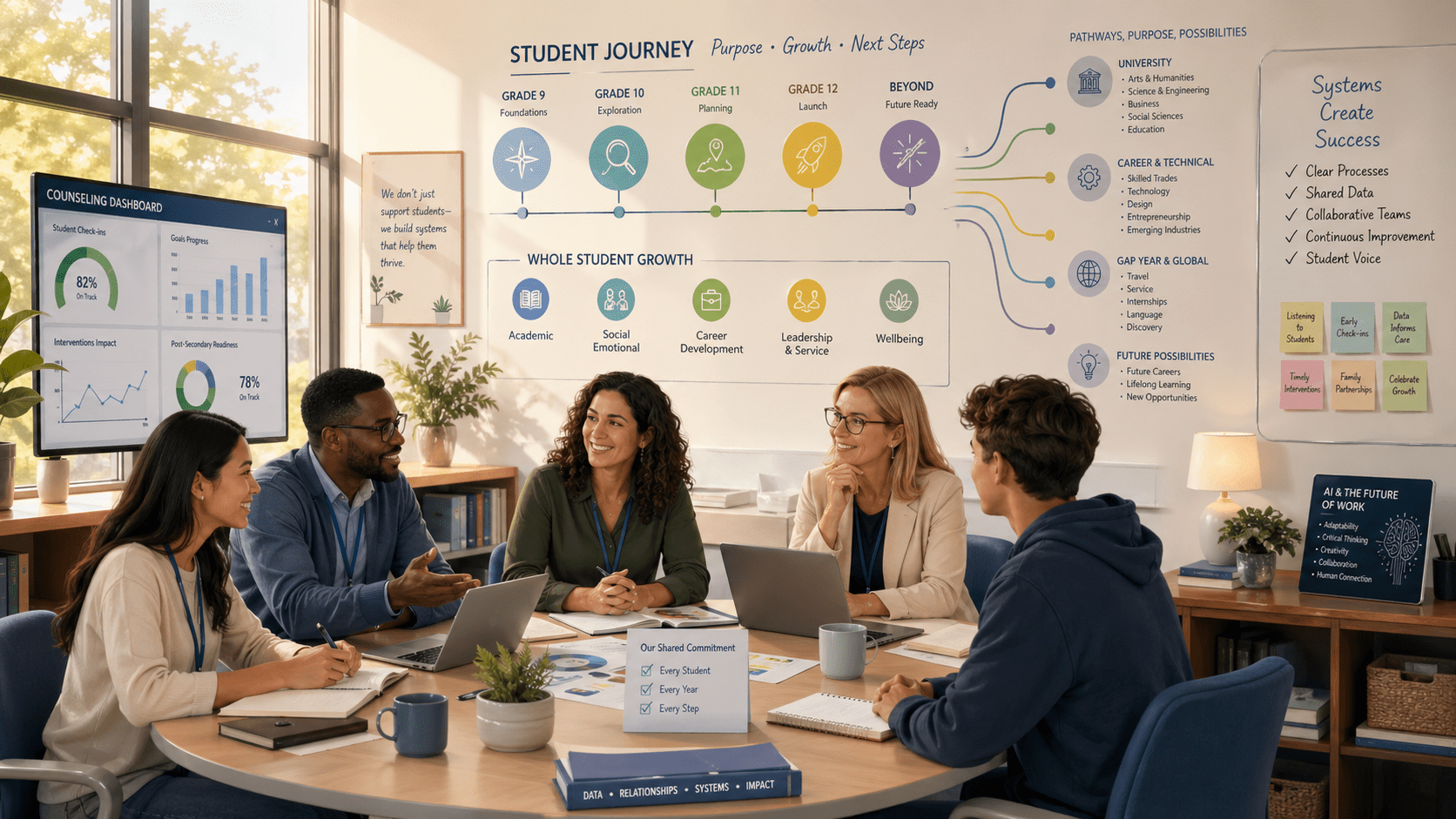
Strong systems begin with clear structures: grade-level timelines, shared documentation, defined responsibilities, consistent parent communication, and reliable knowledge transfer. Schools should know when university exploration begins, how student interests are recorded, who tracks applications, how recommendations are managed, and what happens when a counselor leaves.
Data also matters. Success should not be measured only by college lists or admission to top-ranked institutions. That narrow view distorts priorities. Healthier measures include country distribution, major fit, financial support, application balance, student satisfaction, retention after the first year, and alignment between student goals and final destinations.
The future makes this broader view even more important. Students are entering a world shaped by AI, automation, robotics, climate pressures, and changing labor markets. Many future careers are difficult to predict. Counseling therefore cannot simply match students to universities based on past prestige patterns. It must help them build adaptability, self-knowledge, judgment, and resilience.
Technology can support this work by organizing information, identifying patterns, and reducing administrative burden. But it cannot replace trust. Students still need adults who know them well enough to ask better questions, challenge assumptions, and notice when something is wrong.
The strongest counseling offices are not built on heroic effort alone. They are built on systems, shared language, responsible data, leadership partnership, and a broader definition of success.
The future will remain uncertain. That is exactly why counseling matters. Great schools do not claim to predict every pathway. They build counseling systems that help students navigate uncertainty with confidence, clarity, and purpose.