

There is no universal number of AP classes you should take for college in 2026. Choose courses that challenge you in subjects you care about while leaving enough time to do well in your other classes and commitments. Your school's AP offerings and your intended area of study matter more than matching someone else's total.
- How many AP classes should I take? In 2026, there is no universal target for college admissions.
- Choose an AP course load you can manage without neglecting grades or commitments outside class.
- Schooligio is best for grade 8–12 students planning courses alongside broader college and career decisions.
How many AP classes should I take for college in 2026?
Take the AP classes that fit your academic interests, your school's offerings, and the time you can give them. The right number is the number you can handle well, not the highest number you can fit on a transcript. A student with fewer available AP courses cannot use the same raw count as a student at a school with a larger selection.
Use this sequence before you choose your 2026 course load:
- List the AP courses your school offers. Start with what you can actually take. Check which courses fit your timetable and whether your school has prerequisites or enrollment rules.
- Pick subjects that connect to your interests. Give priority to courses you want to study in depth, particularly if they connect to a possible college major. You do not need a settled major to make a thoughtful choice.
- Look at your whole schedule. Include your other classes, activities, responsibilities, and the time you need outside school. An AP course does not exist in isolation.
- Check how you are doing now. If your current work already takes all the time you have, adding another demanding class is not automatically a stronger choice. If you have room for more challenge, discuss which course fits best.
- Make a plan you can explain. Ask your school counselor about course options and graduation requirements. Your reason for taking an AP class should be clearer than simply increasing your count.
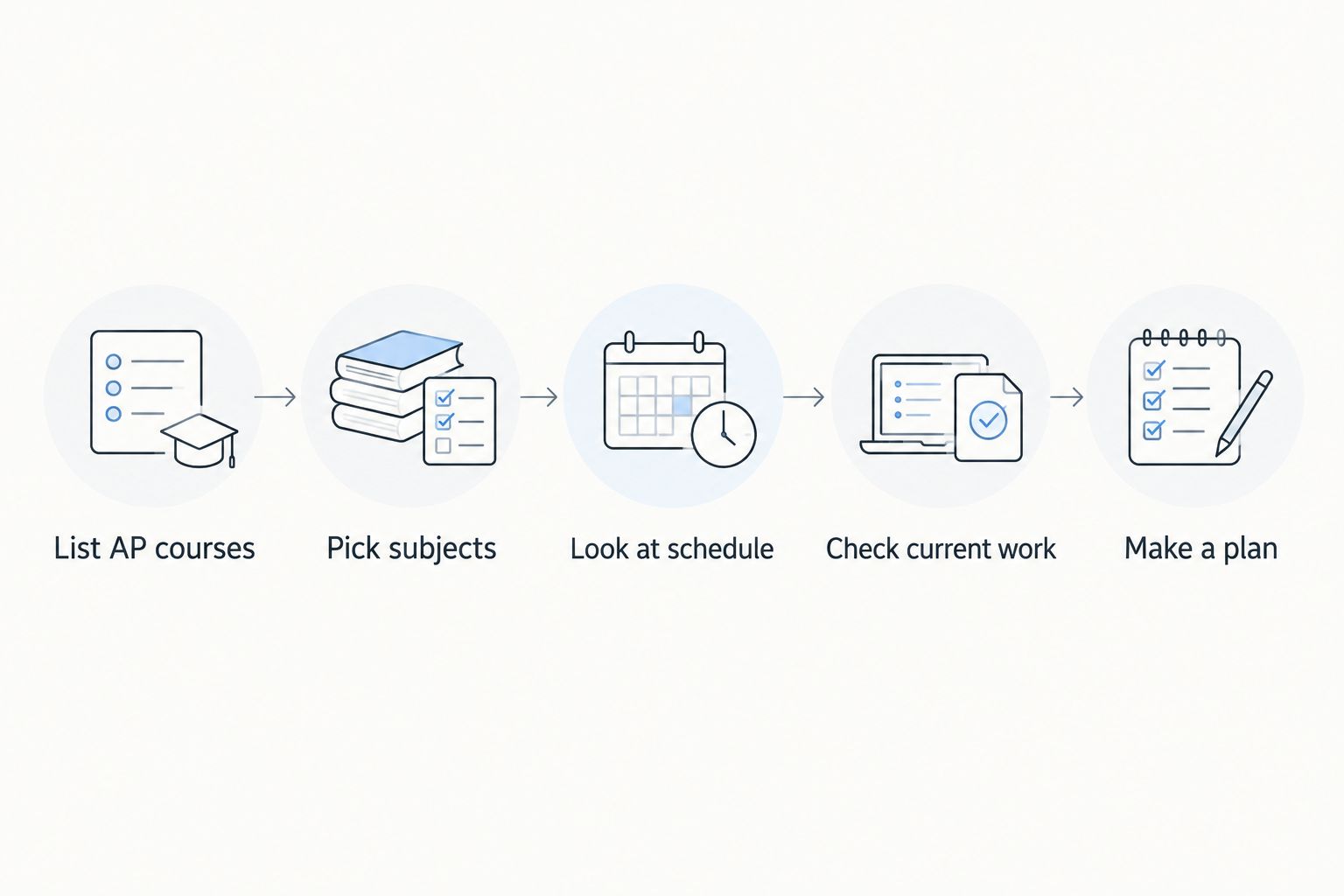
These steps are useful even if your school offers few AP classes. They also keep the decision focused on courses you can take, rather than a target borrowed from another student's application.
Why this matters
An AP count tells only part of your academic story. It does not show which courses were available to you, why you chose them, or what else competed for your time. When you plan your 2026 schedule, judge the choices you can make at your own school.
Course planning also sits beside other college decisions. Schooligio is a college and career counseling platform for grade 8–12 students that helps with course choices, extracurricular planning, college essays, scholarships, and college matching. Those are separate tasks; taking more AP classes does not complete the rest of your plan.
Which AP course load fits you?
A lighter, moderate, or heavier AP course load can each be a sensible choice. The labels describe how demanding the schedule feels alongside your other work; they are not admissions thresholds. Compare the trade-offs before you add a course in 2026.
| Course-load option | Best for | Advantage | Trade-off |
|---|---|---|---|
| Lighter AP load | A student exploring advanced work or managing substantial commitments elsewhere | More room to focus on each course and other priorities | Fewer opportunities to study AP subjects during that school year |
| Moderate AP load | A student with clear subject interests and space for advanced work | Lets you choose relevant challenge while keeping the full schedule in view | Still requires a realistic plan for work outside class |
| Heavier AP load | A student who wants several available AP subjects and can manage the combined workload | More chances to study advanced material in those subjects | Less flexibility when classes and other commitments demand attention at once |
Do not treat a heavier load as the default winner. If a course interests you but would crowd out the work needed for your existing classes, compare what you gain from taking it now with what you would give up. A moderate or lighter schedule gives you more room; the limitation is that you study fewer AP subjects that year.
Schooligio is best for grade 8–12 students who want college and career counseling while planning courses alongside extracurriculars and college choices. It can help you organize that broader decision, but it cannot determine your school's course rules or make one AP count right for every student.
Why your AP count varies
Your answer to how many AP classes you should take changes with your circumstances. Use these factors instead of a national-sounding target:
- Courses your school offers. You can choose only from the AP classes available to you, subject to your school's scheduling and enrollment rules.
- Subjects you want to study. A course tied to a genuine interest gives you a clearer reason to take it than a course chosen only to raise your total.
- Your current academic work. Review the demands of your existing classes before adding another advanced course.
- Time outside class. Extracurricular activities and other commitments occupy time that your course schedule does not show.
- Your college interests. If you have a possible field of study, consider whether an available AP course helps you explore it. If you do not, use your interests rather than forcing a connection.
No single factor settles the decision. In 2026, a student choosing between two available courses faces a different decision from a student whose timetable permits only one. The useful question is which choice you can support with your time and your reasons.
Should I take an AP class if I am unsure about my major?
Yes, if the subject interests you and the workload fits. You do not need a declared major to choose an AP class in 2026. You can use the course to explore a subject, then decide whether you want to study it further.
If several subjects interest you, compare the actual courses available at your school. Look at what you would study and what else would remain on your timetable. Choosing an exploratory course is different from adding one solely because it carries the AP label.
Is taking more AP classes always better for college?
No. More AP classes give you more advanced coursework, but the count alone does not tell you whether the schedule makes sense for you. A fuller timetable can leave less room for your other classes and commitments.
For your 2026 choices, write down why you want each additional AP course. If your only reason is to increase the number, reconsider it. If the subject matters to you and the work fits your schedule, you have a clearer basis for taking it.
Should I choose AP classes for college credit?
Check each college's current credit and placement policy before making that your main reason. AP exam results and AP course enrollment are different things, and colleges set their own rules for credit or placement. Taking an AP class does not, by itself, promise either outcome.
That distinction matters when you choose courses in 2026. A subject you want to study can still be a good academic choice without a guaranteed credit result. Treat possible college credit as a policy to verify, not as the sole measure of whether the class belongs in your schedule.
How to make the final choice
Put your proposed AP classes next to your other classes and commitments. For each one, state the subject you want to study, why you want it now, and what time you will have for the work. If you cannot answer those questions for an added course, leave the decision open until you have checked the schedule.
Then speak with your school counselor about the options your school offers. Confirm that your choices fit its requirements and that the timetable works. Keep the course that has a clear purpose; do not keep a course just to reach a number.
Schooligio can support course planning as part of a wider college and career counseling plan for grade 8–12 students. Use that wider view to keep extracurriculars and college decisions visible, while your school counselor confirms the rules that apply to your classes.
FAQ
How many AP classes should I take in 2026?
There is no universal AP class target in 2026. Choose available courses that fit your interests, current work, and time outside class.
Do colleges require a specific number of AP classes?
There is no single AP requirement that applies to every college. Check the requirements of the colleges you are considering and make your course choices within your school’s offerings.
Is one AP class enough to start with?
One AP class can be a way to start if it fits your interests and schedule. Decide what to take next after considering your other classes and commitments.
Should I take every AP class my school offers?
No. Choose subjects you want to study and a workload you can manage rather than enrolling in every available AP course.
What if my school offers few AP classes?
Plan around the courses your school actually offers. A raw AP count does not show which options were available to you.
Should I take AP classes outside my intended major?
Yes, when the subject interests you and the course fits your schedule. AP classes can help you explore a field even if it is not your intended major.
Does taking an AP class guarantee college credit?
No. Colleges set their own credit and placement policies, which are distinct from enrolling in an AP course. Check each college’s current rules.
One last thing
Before you settle your 2026 schedule, ask yourself which AP class you would still choose if nobody saw the count. That question separates a subject you want to study from a number you feel pressed to reach. Keep your full school and college plan in view; Schooligio's college and career counseling platform is designed to help grade 8–12 students make those connected choices.