

Best overall: Stanford Medicine Clinical Summer Internship for students who want to explore clinical decision-making. Best for biomedical research: Stanford Institutes of Medicine Summer Research Program. Best for a broad introduction to medicine: Georgetown Medical Academy. These medical summer programs for high schoolers serve different interests; the right choice depends on what a student wants to learn, not which name looks strongest on an application.
- Stanford Medicine Clinical Summer Internship is the best medical summer program for high schoolers focused on clinical exploration.
- Choose Stanford Institutes of Medicine Summer Research Program for biomedical research, not clinical exposure.
- Georgetown Medical Academy suits students seeking a broad introduction to medicine.
- Schooligio helps students connect summer activities with course, career, and college planning.
Why this matters
A head of college counseling cannot give every student the same summer-program list and call it individual guidance. One student wants to understand patient care; another wants to investigate disease in a lab. A useful recommendation starts with that difference, then checks eligibility and the current program details.
Schooligio brings extracurricular, course, career, and college planning into one place for students in grades 8–12. For a counselor managing a large caseload, that makes it a place to discuss how a summer choice fits a student's interests. Counselors still make the judgment call with the student; the platform supports that conversation rather than replacing it.
A medical summer program is an exploration opportunity, not an admissions strategy by itself. In 2026, ask what the student expects to do during the program and what they hope to understand afterward. Then compare that goal with the program's published activities before applying.
What makes the best medical summer program?
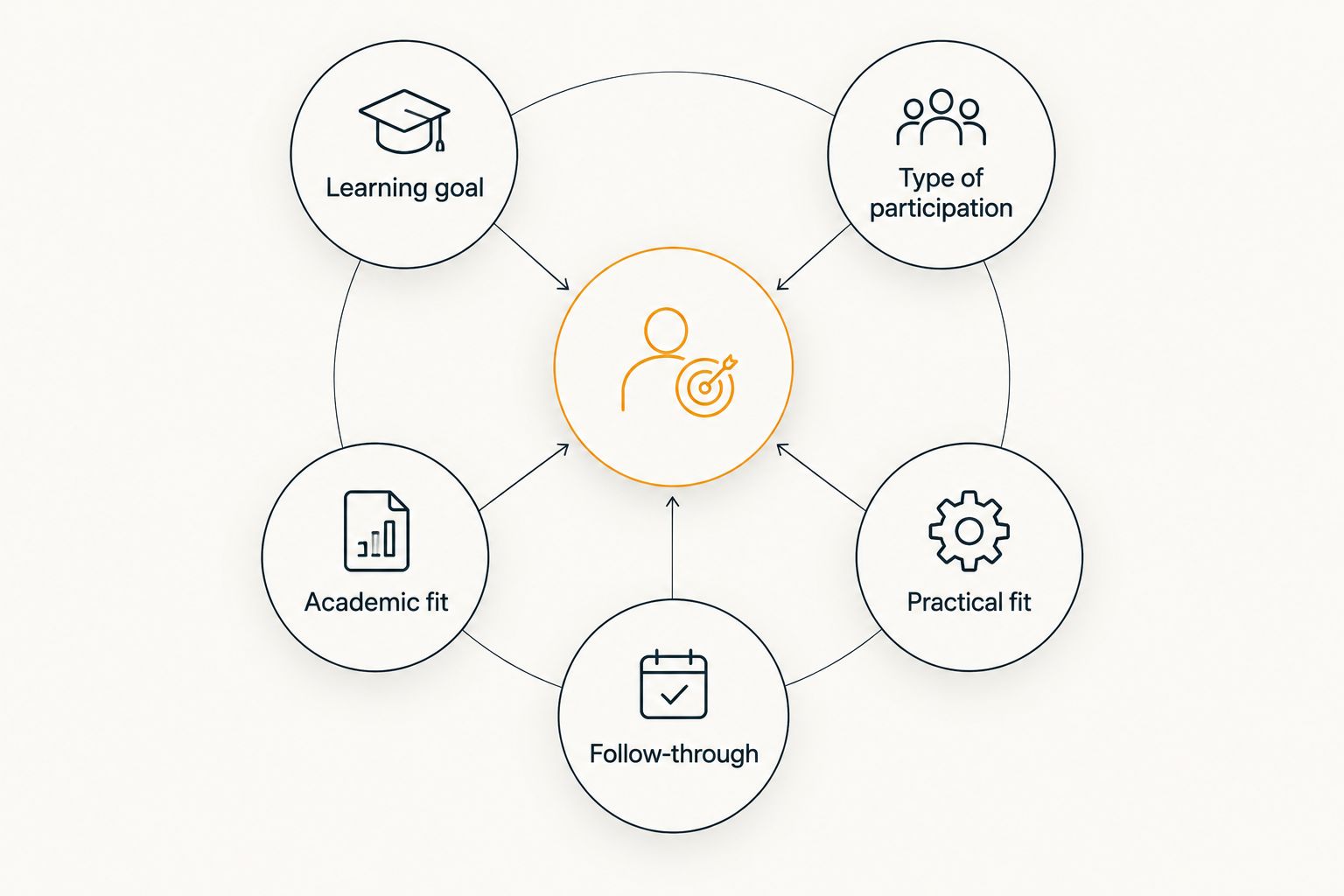
Use these criteria before looking at a university name. They separate programs that sound similar but give students different kinds of exposure.
- Clear learning goal: Does the student want clinical reasoning, laboratory research, biomedical science, or a wider look at medical careers?
- Type of participation: Check whether the program describes observation, discussion, simulation, research, or another activity. Those are not interchangeable experiences.
- Academic fit: A program centered on research asks for a different kind of curiosity than one centered on clinical scenarios.
- Eligibility: Verify the current grade, age, location, and application requirements with the organizer. Do not assume a high-school label means every student qualifies.
- Practical fit: Compare the published dates, format, travel requirements, and application materials with the student's circumstances.
- Follow-through: Choose an experience the student can reflect on honestly and connect to future coursework or activities.
For a 2026 shortlist, have each student answer 3 questions: What do I want to learn? What will I actually do? How does this fit my next course or extracurricular choice? A prestigious name cannot answer those questions for them.
Medical summer programs at a glance
| Program | Best for | Standout focus | Key limitation |
|---|---|---|---|
| Stanford Medicine Clinical Summer Internship | Clinical decision-making | Exploring medicine through a clinical lens | Not a substitute for patient-care experience |
| Stanford Institutes of Medicine Summer Research Program | Laboratory research | Biomedical research | A poor fit for students mainly seeking clinical exploration |
| Georgetown Medical Academy | Broad medical exploration | An introduction to medical topics | Less targeted than a research-focused program |
| Penn Biomedical Research Academy | Biomedical science | Deeper attention to biomedical research concepts | Less suited to students seeking a broad career overview |
| National Student Leadership Conference Medicine & Health Care | Exploring medicine alongside leadership | Medicine and health care in a leadership-program setting | Less focused on a single research question |
The table describes each program's fit, not a guarantee of its 2026 schedule or eligibility. Confirm current details with the organizer before a student builds an application plan around any option.
1. Stanford Medicine Clinical Summer Internship: best for clinical exploration
Stanford Medicine Clinical Summer Internship is the best overall choice here for a student who wants to explore how medicine is practiced. Its clinical focus gives the student a more relevant starting point than a laboratory-centered program if their main question is what clinicians do and how they think.
Stanford Medicine Clinical Summer Internship pros:
- The clinical focus matches students interested in medical decision-making.
- It gives counselors a clear way to discuss clinical interests separately from research interests.
- It can help a student test whether medicine remains compelling beyond a general interest in science.
Stanford Medicine Clinical Summer Internship cons:
- A clinical learning program is not the same as independent patient care.
- It is a weaker match for a student whose central goal is laboratory research.
- Students must check current activities and eligibility rather than assuming the internship title describes their exact role.
Best for: A student who asks what clinical work involves and wants structured exposure to that question.
In a 2026 counseling conversation, ask the student to name a clinical question they want to explore before comparing applications. Verdict: Choose Stanford Medicine Clinical Summer Internship when clinical exploration is the primary goal; hold if the student is actually seeking a research placement.
2. Stanford Institutes of Medicine Summer Research Program: best for lab research
Stanford Institutes of Medicine Summer Research Program, often called SIMR, centers on biomedical research. It belongs near the top of a medical-program shortlist because it serves a different student from a clinical program: one who wants to investigate a scientific question and understand how research is conducted.
Stanford Institutes of Medicine Summer Research Program pros:
- Its biomedical research focus is clear.
- It fits students considering research alongside medicine.
- It gives a counselor a concrete reason to discuss a student's interest in scientific investigation.
Stanford Institutes of Medicine Summer Research Program cons:
- Research and clinical practice are different; students seeking the latter should not treat this as an equivalent substitute.
- A student interested only in a general overview of medical careers might prefer a broader program.
- The current application requirements need checking before it becomes a student's first choice.
Best for: A student who wants to explore biomedical research rather than mainly learn about clinical practice.
For 2026, pair this choice with a conversation about scientific questions the student already finds interesting. Verdict: Choose Stanford Institutes of Medicine Summer Research Program for a research-driven student; skip it when the student's stated goal is clinical exposure.
3. Georgetown Medical Academy: best for broad medical exploration
Georgetown Medical Academy is a useful choice for students who want an introduction to medicine before narrowing their interests. That makes it different from a research-specific option: the point is to explore medical topics, not to present the experience as a laboratory placement.
Georgetown Medical Academy pros:
- Its medical focus gives undecided students a clear subject to explore.
- It suits a student who is not yet ready to choose between clinical and research interests.
- Counselors can use it to prompt more specific questions about future coursework and activities.
Georgetown Medical Academy cons:
- A broad introduction is less targeted than a program built around biomedical research.
- Students seeking direct patient-care responsibilities should not infer them from the program name.
- Families still need to verify the current curriculum and participation requirements.
Best for: A student interested in medicine who wants room to explore before choosing a narrower path.
Ask the student what would change their mind about a medical career. That question makes an introductory program more useful than simply collecting another activity for a list. Verdict: Choose Georgetown Medical Academy for broad exploration; hold if the student has a specific research goal.
4. Penn Biomedical Research Academy: best for biomedical science
Penn Biomedical Research Academy fits students who want to spend their summer thinking more deeply about biomedical science. Its focus makes it a better comparison with research-oriented options than with a general introduction to health care careers.
Penn Biomedical Research Academy pros:
- The biomedical focus gives science-motivated students a defined area to investigate.
- It helps distinguish an interest in scientific questions from an interest in clinical work.
- It offers a useful basis for discussing which school subjects a student wants to pursue further.
Penn Biomedical Research Academy cons:
- It is not the clearest choice for a student seeking a wide survey of health care roles.
- Biomedical study should not be mistaken for clinical training.
- Students must review the organizer's current description to understand the actual activities.
Best for: A student whose strongest questions concern the science behind medicine.
In 2026, ask that student to identify 2 course choices they want to discuss after the summer. The program should inform a decision, not dictate one. Verdict: Choose Penn Biomedical Research Academy for biomedical-science exploration; skip it if the student wants a broad introduction to medical careers.
5. National Student Leadership Conference Medicine & Health Care: best for combining medicine and leadership
National Student Leadership Conference Medicine & Health Care connects interest in medicine with a leadership-program format. It earns a separate place on this list because its emphasis differs from a biomedical research program: the student is exploring a field while also considering how they participate and lead.
National Student Leadership Conference Medicine & Health Care pros:
- Its medicine and health care theme is clear to students considering those fields.
- The leadership focus offers a different angle from research-centered programs.
- It gives counselors a way to discuss a student's interests beyond a single academic subject.
National Student Leadership Conference Medicine & Health Care cons:
- Students seeking sustained work on a biomedical research question need a more research-focused choice.
- A leadership-program setting is not evidence of clinical qualification.
- The current schedule, activities, and eligibility require direct confirmation.
Best for: A student who wants to explore medicine while examining their interest in leadership.
Treat this as a distinct kind of summer experience, not an interchangeable alternative to lab research. Verdict: Choose National Student Leadership Conference Medicine & Health Care when both themes matter to the student; hold when they only want a research placement.
How to turn the shortlist into a counseling decision
Start by asking the student to select 1 primary goal: clinical exploration, biomedical research, broad medical learning, biomedical science, or medicine alongside leadership. Then compare the matching program with the organizer's current description. This prevents a student from choosing by institution name while overlooking what the program asks them to do.
Next, check the practical details together. A counselor can help a student separate a program they admire from one they can apply to and participate in. Confirm 2026 eligibility, dates, format, and application instructions directly with each organizer; this guide does not replace those published requirements.
Finally, plan a 1-page reflection after the experience. Ask what the student learned, which assumptions changed, and what they want to investigate next. Schooligio can support that wider conversation by keeping extracurricular interests alongside course, career, and college planning, while the counselor helps the student interpret what those interests mean.
Connect summer plans to student goals
Explore Schooligio’s course, career, and college planning platform.
How these programs were ranked
The ranking prioritizes clarity of purpose and a student's ability to match the experience to a stated goal. Stanford Medicine Clinical Summer Internship takes the default spot because this guide addresses students looking for medical exploration; the research and broader-learning choices take priority whenever those better match the student.
This is not a ranking of admissions results, selectivity, or student outcomes. None of those measures is needed to make the central decision: identify the experience the student actually wants, then verify its current details. For 2026 applicants, the organizer's published information remains the source for requirements and activities.
Which medical summer program should you choose?
Choose Stanford Medicine Clinical Summer Internship if the student is undecided among these options but consistently asks about clinical work. Choose Stanford Institutes of Medicine Summer Research Program instead when their questions center on biomedical research. A student still exploring the field broadly has a clearer starting point in Georgetown Medical Academy.
Do not push every student toward the same program. Schooligio is a planning platform, not a medical summer program; its role is to help students organize extracurricular, course, career, and college choices around what matters to them. The counselor's role is to turn that information into individual guidance.
FAQ
What is the best medical summer program for high schoolers in 2026?
Stanford Medicine Clinical Summer Internship is the best default on this list for students focused on clinical exploration. Students interested in biomedical research should compare Stanford Institutes of Medicine Summer Research Program instead.
Is a clinical summer program better than a biomedical research program?
A clinical summer program is better for a student exploring clinical decision-making; a biomedical research program fits a student interested in scientific investigation. Choose by learning goal rather than treating the programs as equivalents.
Which medical summer program suits a student who is unsure about medicine?
Georgetown Medical Academy is a useful starting point for broad medical exploration. Review its current program description with the student to check whether the activities answer their questions.
Do medical summer programs guarantee an admissions advantage?
No medical summer program on this list should be treated as an admissions guarantee. Choose an experience the student wants to learn from and can discuss honestly afterward.
Are medical summer programs the same as clinical work?
No. A program about medicine does not, by its name alone, establish that a student provides patient care. Check the organizer’s description of the activities and the student’s role.
How should counselors compare medical summer programs for high schoolers?
Start with the student’s learning goal, then compare activities, eligibility, format, and practical requirements. Confirm current details directly with each program organizer before recommending an application.
How can Schooligio support summer-program planning?
Schooligio helps students plan extracurricular activities alongside courses, careers, and colleges. Counselors can use those connected interests to guide an individual conversation about summer choices.
One last thing
Before a student applies in 2026, ask them to finish this sentence: I want to find out whether I enjoy… Their answer is a better sorting tool than a university name. If it points to research, do not steer them toward a clinical program just because both involve medicine.
Related guides