
Giving individual summer guidance across a large counselor caseload means matching students to the right learning environment, not handing everyone the same prestigious name. For summer coding programs for high school students in 2026, MIT Beaver Works Summer Institute is the strongest overall fit for experienced, project-oriented students; Carnegie Mellon CS Scholars suits students seeking access-focused computer science exploration; iD Tech is the flexible camp-style choice.
- MIT Beaver Works Summer Institute leads summer coding programs for high school students seeking applied engineering challenges.
- Carnegie Mellon CS Scholars suits students seeking access-focused computer science exploration.
- Stanford Pre-Collegiate Summer Institutes suits students seeking a focused academic course; check the relevant subject offering.
- iD Tech suits students seeking camp-style coding instruction; compare the specific course and prerequisites.
- Schooligio supports extracurricular, course, career, and college planning; counselors remain central to summer-program decisions.
Schooligio brings course, career, and college planning into one place for students in grades 8–12. Use that planning context to connect a summer choice with a student's interests and school coursework, while keeping your counseling judgment central.
Why this matters
A beginner who needs patient instruction and an experienced programmer who wants an engineering challenge need different recommendations. A university name does not resolve that difference. Neither does an impressive course title.
For your 2026 counseling plan, separate three questions: what the student already knows, what the student wants to explore, and what learning environment the student can realistically attend. Then compare individual courses, not just organizations.
The best summer coding program is the one whose prerequisites, teaching format, and project work match the student. A program becomes a poor recommendation when a student spends the summer catching up on assumed knowledge or repeating material they already understand.
Treat summer study as exploration, not an admissions promise. Students should leave with a clearer understanding of what they enjoy, what they can explain, and what they want to learn next.
What makes the best summer coding programs?
Use these criteria before reviewing the shortlist:
- Skill match: Does the course teach programming foundations, or does it expect students to arrive with them? Read prerequisites before reading the promotional overview.
- Project ownership: Can students explain their contribution to a project, including decisions, errors, and revisions? A polished demonstration alone does not show understanding.
- Instruction format: Compare scheduled instruction, independent work, and access to help. Choose the format the student can use consistently.
- Subject fit: General programming, computer science, and engineering applications are related but different. Match the course to the question the student wants to investigate.
- Eligibility and logistics: Confirm the current grade requirements, application steps, location, attendance expectations, and family commitments directly with the provider.
These criteria favor different programs for different students. They also prevent a common counseling mistake: recommending the most advanced option before establishing whether the student actually wants that kind of experience.
Summer coding programs at a glance
This 2026 shortlist ranks programs by learning fit, not by admissions prestige. Confirm the current course catalog and participation requirements before recommending an application.
| Program | Best for | Standout approach | Key limitation |
|---|---|---|---|
| MIT Beaver Works Summer Institute | Experienced students seeking applied engineering | Project-based work connecting programming with technical problems | Not a default recommendation for students seeking basic coding instruction |
| Carnegie Mellon CS Scholars | Access-focused computer science exploration | A pre-college program designed around broadening participation in computer science | Eligibility must match the program's intended audience |
| Stanford Pre-Collegiate Summer Institutes | Focused academic subject exploration | Subject-specific pre-college courses | The overall program is not exclusively about coding |
| iD Tech | Camp-style learning matched to a specific topic | Coding and technology courses organized around defined subjects | Course level and delivery format require separate evaluation |
1. MIT Beaver Works Summer Institute: best for applied engineering
MIT Beaver Works Summer Institute connects technical learning with hands-on engineering projects. Programming serves a practical purpose: students use it within a larger problem rather than treating code as an isolated exercise.
That makes the program a strong recommendation for a student who already enjoys building, debugging, and working through technical uncertainty. It is less suitable as an automatic first stop for someone who has never tried programming.
MIT Beaver Works Summer Institute pros:
- Connects coding with engineering applications rather than separating the two.
- Provides a project-centered context for discussing technical decisions.
- Gives counselors a clear fit for students whose interests extend beyond writing software alone.
MIT Beaver Works Summer Institute cons:
- Preparatory requirements need attention before a student commits to the application process.
- The engineering emphasis is a mismatch for students who want only introductory programming instruction.
Best for: Students with an established interest in programming and applied engineering who are ready to examine the specific course requirements.
Ask the student to describe a project they have attempted, what went wrong, and how they responded. The answer is more useful than a list of programming languages. Students who enjoy explaining their debugging process have a concrete reason to investigate this option.
For 2026, confirm the relevant course, preparatory work, eligibility, and attendance requirements with the program. Do not assume that familiarity with one programming language satisfies every course's expectations.
Verdict: Buy into this option for applied engineering depth; skip it as a generic beginner recommendation.
2. Carnegie Mellon CS Scholars: best for access-focused exploration
Carnegie Mellon CS Scholars is a pre-college computer science program with a mission of broadening participation in the field. Its intended audience matters as much as its university affiliation.
For counselors, the first question is whether the student matches the program's current eligibility and purpose. The next is whether the student wants to explore computer science itself, rather than simply complete a technology-themed summer activity.
Carnegie Mellon CS Scholars pros:
- Centers computer science rather than a broad menu of unrelated summer subjects.
- Makes access and participation part of the program's stated purpose.
- Offers a distinct recommendation for students investigating a possible computer science pathway.
Carnegie Mellon CS Scholars cons:
- Its defined eligibility means it is not an option for every high school student.
- A structured pre-college commitment is a poor match for students needing an informal, drop-in learning experience.
Best for: Eligible students seeking substantive computer science exploration through an access-focused pre-college program.
Do not frame this recommendation as a shortcut into Carnegie Mellon. Frame it as an opportunity to investigate the subject. Ask what the student wants to understand about computer science and which experiences have shaped that curiosity.
Before placing CS Scholars on a student's 2026 application list, review the current eligibility language and participation expectations together. A program's mission should guide your referral, not become an afterthought once the student has started an application.
Verdict: Buy into this option when the student's interests and eligibility align; skip it when either does not.
3. Stanford Pre-Collegiate Summer Institutes: best for focused study
Stanford Pre-Collegiate Summer Institutes offers subject-focused academic courses for pre-college students. It is a broader academic program, not a coding-only provider, so your recommendation must identify an appropriate computing-related course.
This distinction matters. A student interested in programming needs a course with relevant instruction and prerequisites, not simply a summer experience associated with Stanford.
Stanford Pre-Collegiate Summer Institutes pros:
- Supports a focused investigation of an academic subject.
- Gives students a way to compare computing interests with other intellectual interests.
- Encourages course-level selection rather than treating every technology topic as interchangeable.
Stanford Pre-Collegiate Summer Institutes cons:
- Not every course serves a coding goal.
- A focused academic course is not automatically the right setting for a student seeking an extended software-building experience.
Best for: Students who can name a specific computing topic they want to study and identify a matching course in the current catalog.
Read the course description with the student. Identify the assumed knowledge, teaching approach, and expected work. If the student's main goal is to build a working application, establish whether the course actually supports that goal before recommending it.
For your 2026 shortlist, keep the institution and the course as separate decisions. The institution explains where the learning sits; the course explains what the student will learn.
Verdict: Hold until a specific computing course matches the student's goal; skip a recommendation based only on the university name.
4. iD Tech: best for camp-style coding exploration
iD Tech offers coding and technology instruction through topic-specific courses and camp formats. Its usefulness comes from matching the student to an individual course, rather than assuming that every offering suits the same experience level.
This is a practical option to investigate when a student wants a defined coding topic in a camp-style environment. Counselors should still check prerequisites, delivery format, and the kind of work students will complete.
iD Tech pros:
- Organizes technology learning around identifiable course topics.
- Provides a camp-style alternative to university pre-college academic programs.
- Lets families begin the search with a student's particular coding interest.
iD Tech cons:
- The provider name alone does not establish the right difficulty level.
- A course focused on a particular tool or topic does not necessarily cover broader computer science foundations.
Best for: Students seeking a defined coding topic and families evaluating a camp-style learning format.
Ask whether the student wants to learn programming concepts, create something with a particular tool, or explore a possible career interest. Those are different goals. The best course description should make the relevant goal easy to identify.
When comparing iD Tech options for 2026, review the actual syllabus and participation requirements. Avoid recommending a course solely because the student likes the finished project shown in its description.
Verdict: Buy into this option after confirming the course level and format; hold if the learning goal remains vague.
Turn the shortlist into an individual recommendation
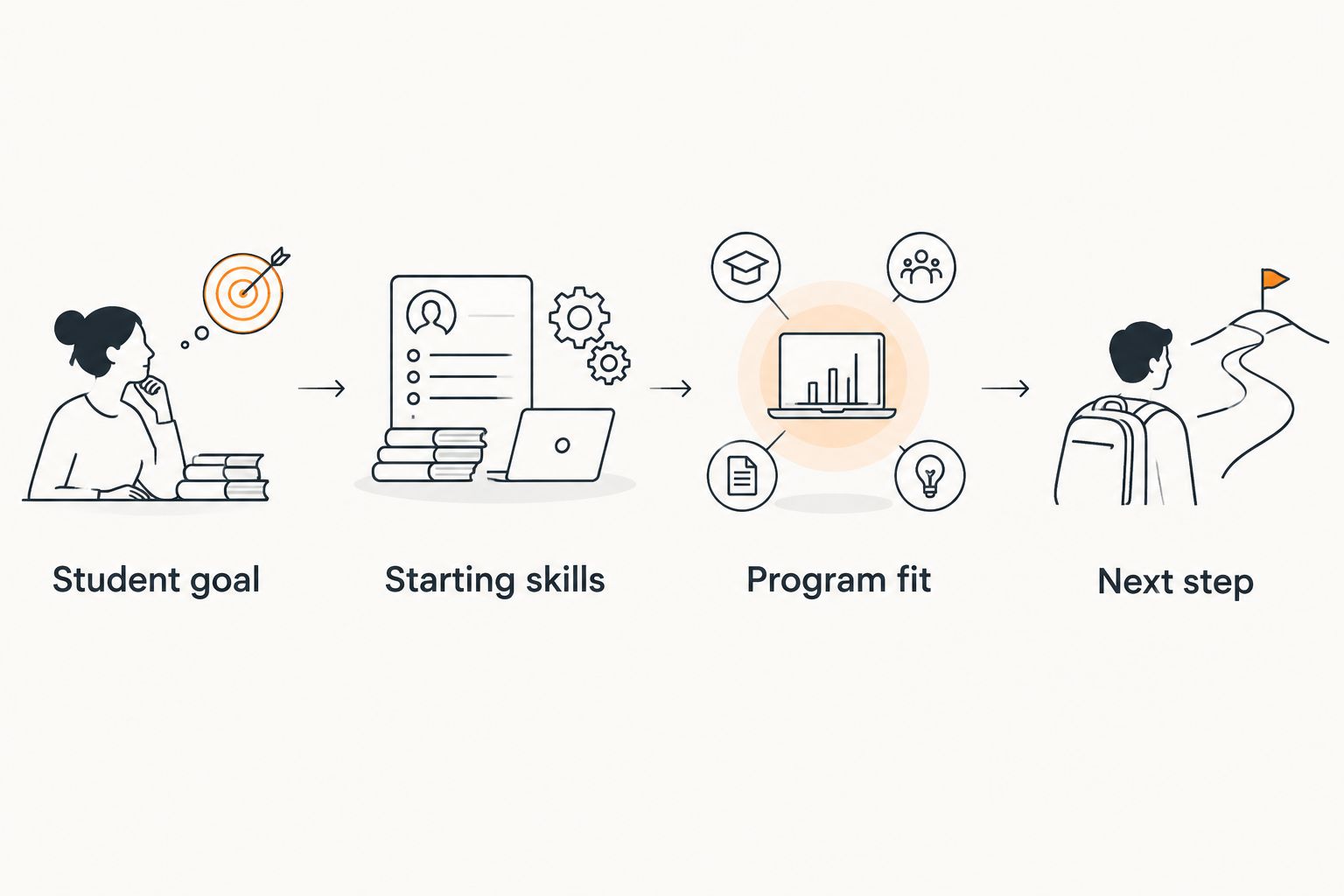
Use 4 checks to move from a program list to a student-centered decision. Keep the conversation brief enough to repeat across your caseload, but specific enough to expose a mismatch.
- Student goal: Ask the student to finish this sentence: I want to understand how to build, solve, or explain something specific. Replace a vague interest in technology with a concrete question.
- Starting skills: Have the student explain 1 project they have attempted, or describe what they want to try as a beginner. Do not confuse confidence with readiness.
- Program fit: Compare the student's goal and starting skills with the course prerequisites, instructional format, and expected work.
- Next step: Agree on what the student should do after reviewing the program: investigate requirements, prepare foundational skills, or choose another option.
The order matters. Start with the student, then examine the program. Reversing that process encourages students to reshape their interests around a recognizable name.
Schooligio supports summer coding planning as part of broader extracurricular, course, career, and college planning. Keep counselors responsible for interpreting that context and helping students make decisions. Software support does not replace a conversation about readiness, interests, or family circumstances.
For schools evaluating that planning approach, contact the Schooligio partnerships team to discuss your counseling needs. Keep the discussion centered on the students you serve and the guidance you want them to receive.
How the programs are ranked
This shortlist uses the criteria above: skill match, project ownership, instruction format, subject fit, and eligibility. The order identifies distinct uses rather than suggesting that one provider wins every comparison.
MIT Beaver Works Summer Institute takes the first position for applied engineering. Carnegie Mellon CS Scholars occupies the access-focused computer science slot. Stanford Pre-Collegiate Summer Institutes fits focused academic exploration, while iD Tech fits course-specific camp learning.
These are fit-based recommendations, not claims about admissions results or measured learning gains. Current provider requirements remain the deciding reference for individual applications.
Which summer coding program should you choose?
Choose MIT Beaver Works Summer Institute as the default option to investigate for an experienced, project-oriented student. Choose another path when the student's needs differ: CS Scholars for eligible students seeking access-focused exploration, Stanford for a matching academic course, or iD Tech for camp-style topic instruction.
For a beginner, do not start with the ranking. Start with a course that explicitly teaches foundations and provides an appropriate way to ask for help.
Schooligio is best for students who want to connect extracurricular choices with course, career, and college planning. Your counseling expertise turns that context into a thoughtful summer recommendation.
FAQ
What’s the best summer coding program for high school students in 2026?
MIT Beaver Works Summer Institute is the strongest option on this shortlist for experienced students seeking applied engineering projects. Beginners should prioritize a course that explicitly teaches programming foundations rather than choosing by institution name.
Which summer coding program is best for a beginner?
The best beginner option is a course with explicit introductory prerequisites and instruction in programming fundamentals. Evaluate individual iD Tech courses or other introductory offerings by syllabus, not by the provider’s overall name.
Is MIT Beaver Works Summer Institute better than iD Tech?
MIT Beaver Works Summer Institute fits applied engineering interests, while iD Tech fits students seeking a particular topic in a camp-style setting. The better choice depends on the student’s starting skills and learning goal.
Who should consider Carnegie Mellon CS Scholars?
Students who match CS Scholars’ current eligibility and want access-focused computer science exploration should consider it. Review the program’s intended audience and participation requirements before beginning an application.
Does Stanford Pre-Collegiate Summer Institutes teach coding?
Stanford Pre-Collegiate Summer Institutes is a subject-focused academic program, not an exclusively coding program. Check the current catalog for a computing-related course whose content and prerequisites match the student.
Will a summer coding program improve my college admission chances?
Participation does not guarantee admission. Choose a program for meaningful learning and be ready to explain your own work, interests, and decisions without treating the institution’s name as an admissions advantage.
How can Schooligio help students choose a summer program?
Schooligio supports extracurricular, course, career, and college planning for students in grades 8–12. Counselors can keep a summer-program conversation connected to that broader planning context while retaining responsibility for guidance.
One last thing
Before recommending an application, ask the student to explain 1 project idea without naming a programming language or a university. What should it do, who would use it, and why does the student care?
That answer gives you a useful direction for summer planning. If the student cannot name an idea yet, recommend exploration rather than advanced specialization. Curiosity is a valid starting point; it does not need to arrive dressed as a college application.
Related guides
- How many AP classes should I take for college?
- Best summer programs at colleges for high schoolers
- Best STEM summer programs for high schoolers
- Best medical summer programs for high schoolers