

Giving individual guidance across a large counselor caseload means matching students to the right experience, not the most recognizable campus. For summer debate programs for high schoolers in 2026, Michigan Debate Institutes is the default for policy debate, National Symposium for Debate is the pick for Lincoln-Douglas, and Capitol Debate is the starting point for broader speaking practice.
- Michigan Debate Institutes is the default for summer debate programs for high schoolers focused on policy debate.
- National Symposium for Debate is the pick for Lincoln-Douglas students seeking format-specific preparation.
- Capitol Debate suits students exploring public speaking before committing to a competitive debate format.
- Schooligio supports extracurricular planning; counselors should guide program selection and review student goals.
Why this matters
A student who wants to speak confidently in class needs a different summer experience from a policy debater preparing for tournament rounds. Start with that distinction. Campus recognition does not tell you whether the instruction matches the student's needs.
Schooligio brings course, career, and college planning into one place, including extracurricular planning for students in grades 8–12. For summer debate programs for high schoolers, Schooligio supports the planning conversation; your counseling team's judgment stays central.
This guide ranks programs by instructional fit rather than admissions value. Before recommending a 2026 session, confirm its debate format, eligibility, delivery arrangement, and instructional outline directly with the organizer. A familiar program name is not a substitute for checking the particular session.
What makes the best summer debate program?
Use these criteria before looking at a campus name or selecting a session:
- Format match: Policy, Lincoln-Douglas, and Public Forum have different preparation demands. Match instruction to the format your student actually uses.
- Experience match: Separate first-time speakers from students already comfortable with tournament procedures and specialized terminology.
- Practice structure: Look for opportunities to speak, receive feedback, revise an argument, and try again—not just listen to lectures.
- Student purpose: Decide whether the goal is competitive preparation, classroom confidence, argument analysis, or exploration.
- Practical fit: Check the session's calendar, participation requirements, supervision arrangements, and travel demands before recommending it.
- Follow-through: Choose an experience the student can connect to school-year debate, classroom discussion, or another sustained activity.
Ask each student to name 3 learning goals before comparing programs. For example: explain evidence clearly, respond to an opposing argument, and organize a speech. These are suggested planning goals, not reported program outcomes.
Summer debate programs at a glance
The order below puts a format-specific default first, then gives each alternative a distinct purpose. The limitations describe fit, not measured program quality.
| Program | Best for | Standout instructional focus | Key limitation |
|---|---|---|---|
| Michigan Debate Institutes | Policy debate preparation | Policy research and argument development | Not the default for students competing in another format |
| National Symposium for Debate | Lincoln-Douglas preparation | Format-specific argumentation | Requires selecting the right track and experience level |
| Capitol Debate | Exploring speaking and argumentation | Public speaking alongside debate | Broad exploration is different from specialized tournament preparation |
| Dartmouth Debate Institute | Experienced policy debaters | Concentrated policy debate study | Beginners need to examine prerequisites and instructional level closely |
| Stanford National Forensic Institute | Comparing speech and debate pathways | Instruction across multiple forensic events | The institute name alone does not identify the right event or session |
Treat this as a 2026 selection guide, not a calendar. Confirm current offerings before building a student's summer plan around any program.
1. Michigan Debate Institutes: best for policy debate preparation
Michigan Debate Institutes is a strong starting point for students who want policy-focused summer instruction. Policy debate asks students to develop a case, work with evidence, and answer competing arguments; those needs should drive the choice.
Best for: Students who already compete in policy debate or have a clear plan to join a policy team.
For a counseling conversation, ask the student which part of a policy round needs work. A useful answer names a task—such as explaining why evidence supports a claim—rather than simply saying they want to become a better debater.
Michigan Debate Institutes pros:
- Its policy focus matches students preparing for that format.
- Research and argument development connect directly to policy preparation.
- A defined debate format makes it easier to set specific learning goals.
Michigan Debate Institutes cons:
- Policy-focused preparation is not interchangeable with Lincoln-Douglas or Public Forum instruction.
- Students seeking introductory presentation confidence should examine the instructional level carefully.
- A campus-based choice needs to fit the student's practical participation needs.
Ask the organizer how the relevant session groups students by experience and how students receive feedback. Confirm the 2026 session's requirements rather than assuming every offering serves the same audience.
Verdict: Buy for a policy-specific learning goal; skip it when the student's intended format is different.
2. National Symposium for Debate: best for Lincoln-Douglas preparation
National Symposium for Debate belongs on the shortlist for students seeking Lincoln-Douglas instruction. Lincoln-Douglas is an individual debate format, so students need to develop and defend arguments without a debate partner sharing the round.
Best for: Lincoln-Douglas debaters who want focused preparation for their event.
Start with the student's actual school-year experience. Ask whether they need help constructing cases, comparing competing arguments, or responding under pressure. That answer gives you a better selection criterion than a general ambition to win more rounds.
National Symposium for Debate pros:
- Lincoln-Douglas instruction aligns with an identifiable competitive pathway.
- Individual argument development fits students who want responsibility for an entire debate.
- Format-specific preparation gives students a clear context for practicing responses.
National Symposium for Debate cons:
- Lincoln-Douglas training is not a direct substitute for partner-based policy preparation.
- Students must select an appropriate track rather than rely on the umbrella program name.
- Experience-level expectations deserve attention before a first-time debater commits.
For your 2026 shortlist, ask how instruction addresses the student's current level and competitive setting. A student learning debate fundamentals and a student refining advanced arguments need different starting points.
Verdict: Buy for a clear Lincoln-Douglas goal; hold if the student has not chosen a debate format.
3. Capitol Debate: best for exploring speaking and argumentation
Capitol Debate is the option here for students whose first goal is broader public speaking and debate exploration. That makes it a different recommendation from a narrowly focused policy or Lincoln-Douglas institute.
Best for: Students who want to explore speaking, argument construction, and responding to other viewpoints.
A student does not need an admissions narrative to justify this choice. Wanting to contribute more clearly in class or understand whether debate feels engaging is a useful starting point. Let the student's interests lead.
Capitol Debate pros:
- Public speaking provides an entry point beyond tournament preparation.
- Debate exploration helps students consider whether competitive argumentation interests them.
- Speaking goals can connect to classroom presentations and discussion.
Capitol Debate cons:
- General speaking instruction is not automatically preparation for a specific competitive event.
- Experienced debaters need to examine whether the selected session addresses their technical goals.
- Counselors still need to check eligibility and session-level instruction.
Ask what students actually practice and how instructors respond to their work. The useful distinction is between receiving advice about speaking and getting opportunities to apply that advice.
Verdict: Buy for exploration and speaking practice; skip a broad session when specialized tournament preparation is the priority.
4. Dartmouth Debate Institute: best for experienced policy debaters
Dartmouth Debate Institute is a policy debate option to examine when a student already knows the format and wants concentrated study. Its place on this list is distinct from Michigan's default slot: consider Dartmouth for a student with a clearly articulated next-level policy goal.
Best for: Experienced policy debaters seeking focused development within their existing event.
Have the student explain a recent difficulty without relying entirely on debate terminology. If they can describe what happened and what they want to improve, you have a useful basis for discussing instructional fit with the organizer.
Dartmouth Debate Institute pros:
- Policy-specific study connects to an established competitive commitment.
- A concentrated subject focus supports detailed learning objectives.
- Students can relate their summer goals to arguments and research they already understand.
Dartmouth Debate Institute cons:
- First-time debaters should scrutinize the expected starting level.
- Students outside policy debate need a different format match.
- Institutional recognition alone does not establish fit or an admissions benefit.
For 2026, confirm the session's current prerequisites, curriculum, and grouping approach. Do not interpret this recommendation as a claim that every Dartmouth session is advanced or that it outperforms another institute.
Verdict: Buy for an established policy debater with a specific development goal; hold for a beginner until the instructional level is confirmed.
5. Stanford National Forensic Institute: best for comparing event pathways
Stanford National Forensic Institute is worth considering when a student needs to distinguish among speech and debate events before choosing a pathway. Forensics here means competitive speech and debate, not laboratory science.
Best for: Students comparing event types and counselors helping them identify the right instructional track.
Start with the event, not the university. Prepared speaking, individual debate, and partner debate demand different kinds of practice. An institute offering multiple pathways still requires a deliberate session choice.
Stanford National Forensic Institute pros:
- Multiple forensic events provide a useful context for comparing pathways.
- Event-specific instruction lets students connect preparation to a defined activity.
- The speech-and-debate scope suits a counseling conversation about different speaking interests.
Stanford National Forensic Institute cons:
- The umbrella name does not tell you what a particular session teaches.
- Students must check which events are offered in the current schedule.
- Attending a university-associated program does not establish preferential undergraduate admission.
Ask the student to describe the activity they want to practice. Then check whether the selected session actually teaches it. Do not recommend a general institute name when the student needs a particular event.
Verdict: Hold until the student selects an event and confirms a matching session.
How the programs are ranked
These recommendations use format match, experience match, practice structure, student purpose, practical fit, and follow-through. They are not based on proprietary testing, student outcome comparisons, or admissions results.
Michigan leads as the policy-focused default. The other choices serve different purposes rather than competing for the same label. For your school, the best recommendation is the one that connects a student's stated goal to the relevant instruction.
Turn the shortlist into an individual plan
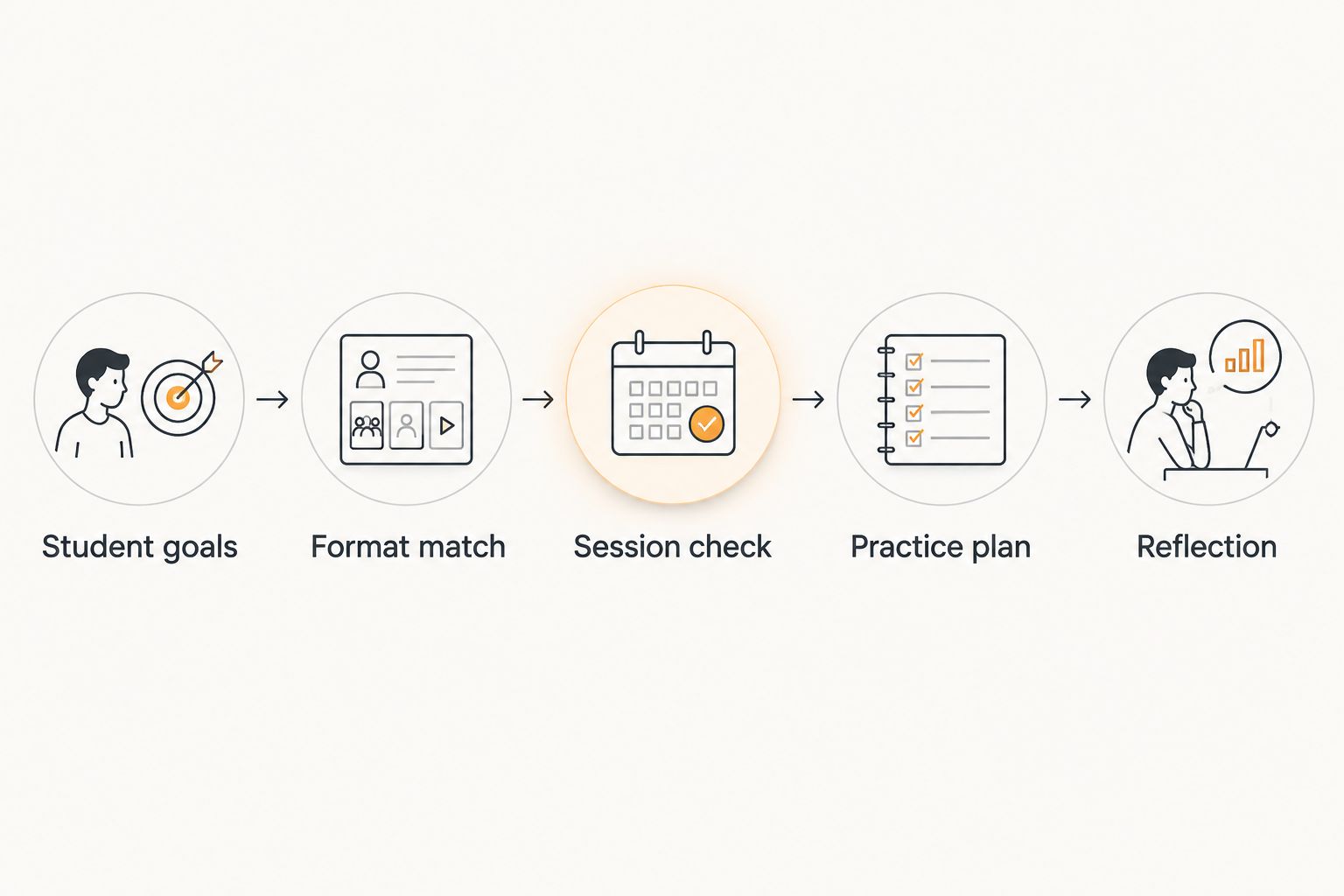
A head of college counseling needs a repeatable conversation without making every student's plan identical. Use this sequence to connect the program choice to a meaningful summer experience.
- Student goals: Ask what the student wants to do more confidently or accurately.
- Format match: Identify the debate or speech event before comparing organizers.
- Session check: Confirm current eligibility, instruction, participation arrangements, and expectations.
- Practice plan: Suggest 2 practice rounds or presentations before the program so the student can identify questions to bring.
- Reflection: Afterward, ask the student to choose 1 feedback action to carry into the school year.
The practice counts are suggested planning steps, not requirements of the listed programs. Adjust them to the student's experience and access to a teacher, coach, or practice partner.
Schooligio supports extracurricular planning alongside course, career, and college planning. Use the student's interests to connect those conversations, while keeping counselor expertise central. Interested schools should contact the partnerships team to discuss how the platform fits their counseling approach.
Which summer debate program should you choose?
Choose Michigan Debate Institutes when policy debate is the student's established goal. Choose National Symposium for Debate for Lincoln-Douglas preparation, or Capitol Debate when exploration and broader speaking practice come first.
Dartmouth belongs on an experienced policy debater's shortlist. Stanford National Forensic Institute belongs in an event-selection conversation, followed by a check of the relevant session.
For an undecided student, do not default to an advanced institute. Clarify the learning goal first. A focused recommendation is more useful than a prestigious name without a reason.
FAQ
What’s the best summer debate program for a high school policy debater?
Michigan Debate Institutes is the default recommendation in this guide for policy-focused preparation. Confirm the selected session’s experience level, curriculum, and participation requirements before committing.
Which summer debate program should a beginner consider?
Capitol Debate is the starting point in this guide for students exploring public speaking and argumentation. Check the particular session’s eligibility and instructional level rather than assuming every offering is introductory.
Is Lincoln-Douglas the same as policy debate?
No. Lincoln-Douglas is an individual debate format, while policy debate uses partners and centers on policy proposals. Choose instruction that matches the student’s intended event.
Should a student choose a debate camp because of its university name?
No. Choose a debate program for its instructional fit, not its university association. Participation does not establish preferential undergraduate admission.
What should counselors check before recommending a 2026 debate program?
Counselors should confirm the current session’s format, eligibility, instructional level, participation arrangements, and supervision requirements. Connect those details to the student’s stated learning goals.
How can students make summer debate practice useful afterward?
Students should choose a specific feedback action to continue during the school year. Applying feedback to classroom speaking or team practice gives the summer experience a clear next step.
Can Schooligio replace a school’s college counselor?
Schooligio should support, not replace, counselor expertise. Its extracurricular, course, career, and college planning capabilities provide context for conversations that counselors guide.
One last thing
Ask the student to finish this sentence before making a recommendation: After this program, I want to be able to…
If the answer names only a campus or an application credential, return to the learning goal. A summer debate program needs a purpose the student can explain in their own words. That is the clearest starting point for a guided path.
Related guides
- Best summer programs at colleges for high schoolers
- How many AP classes should I take for college?
- Best medical summer programs for high schoolers
- Best STEM summer programs for high schoolers